Welcome to IPv6 🌱
So IPv6 is the next generation Internet Protocol … well in the 1990s it was.
Today IPv6 is fully working, but ignored in many places. Especially in Denmark we do NOT have a lot of IPv6 enabled networks, hosts and services.
Internet Protocol version 6 (IPv6) is the most recent version of the Internet Protocol (IP), the communications protocol that provides an identification and location system for computers on networks and routes traffic across the Internet. IPv6 was developed by the Internet Engineering Task Force (IETF) to deal with the long-anticipated problem of IPv4 address exhaustion, and was intended to replace IPv4.[1] In December 1998, IPv6 became a Draft Standard for the IETF,[2] which subsequently ratified it as an Internet Standard on 14 July 2017.[3][4]
Source: Wikipedia IPv6
What is IPv6
The main protocol used for transporting Internet Protocol packets is called IP, and IPv6 is just the version with a magic number 6 in the header for the version. This number was allocated by Internet Assigned Numbers Authority (IANA) which has registries for all the magic constants we use on the internet – including addresses, ports and protocol numbers.
3.  IPv6 Header Format
   +-+-+-+-+-+-+-+-+-+-+-+-+-+-+-+-+-+-+-+-+-+-+-+-+-+-+-+-+-+-+-+-+
   |Version| Traffic Class |           Flow Label                  |
   +-+-+-+-+-+-+-+-+-+-+-+-+-+-+-+-+-+-+-+-+-+-+-+-+-+-+-+-+-+-+-+-+
   |         Payload Length        |  Next Header  |   Hop Limit   |
   +-+-+-+-+-+-+-+-+-+-+-+-+-+-+-+-+-+-+-+-+-+-+-+-+-+-+-+-+-+-+-+-+
   |                                                               |
   +                                                               +
   |                                                               |
   +                         Source Address                        +
   |                                                               |
   +                                                               +
   |                                                               |
   +-+-+-+-+-+-+-+-+-+-+-+-+-+-+-+-+-+-+-+-+-+-+-+-+-+-+-+-+-+-+-+-+
   |                                                               |
   +                                                               +
   |                                                               |
   +                      Destination Address                      +
   |                                                               |
   +                                                               +
   |                                                               |
   +-+-+-+-+-+-+-+-+-+-+-+-+-+-+-+-+-+-+-+-+-+-+-+-+-+-+-+-+-+-+-+-+
Source: Internet Protocol, Version 6 (IPv6) Specification RFC8200
How to use IPv6
So when we send information on the Internet today, we basically either use IP version 4 or IP version 6, both work in parallel. They are not completely compatible, but we can use both.
So we can have a system with both protocols select which one to use, and often try both.
Say you want to visit this site https://garden.kramse.org your browser will do a DNS lookup, and connect to the address:
$ host garden.kramse.org
garden.kramse.org has address 185.129.62.180
garden.kramse.org has IPv6 address 2a06:d380:0:9985::1
The command host looks up the addresses on the command line, which is a built-in function in your browser. Then your browser would decide to connect to either the IPv4 shown first, or the IPv6 address – written with colons here.
Since I specified HTTPS your browser knows to use encryption also with Transport_Layer_Security (TLS) – which by default uses port 443.
Techical Details
If you want to lookup deeper a combination of protocols work together:
- Domain Name System (DNS) looks up the domain using the name service, which would typically use User Datagram Protocol (UDP) with port 53
- Transmission Control Protocol (TCP) which is the application level protocol with port number 443 – could become QUIC using UDP in the future
- Below the TCP we would have either IPv4 or IPv6 which has the addresses - like an envelope
We often consider these protocol stacks or suites of protocols:
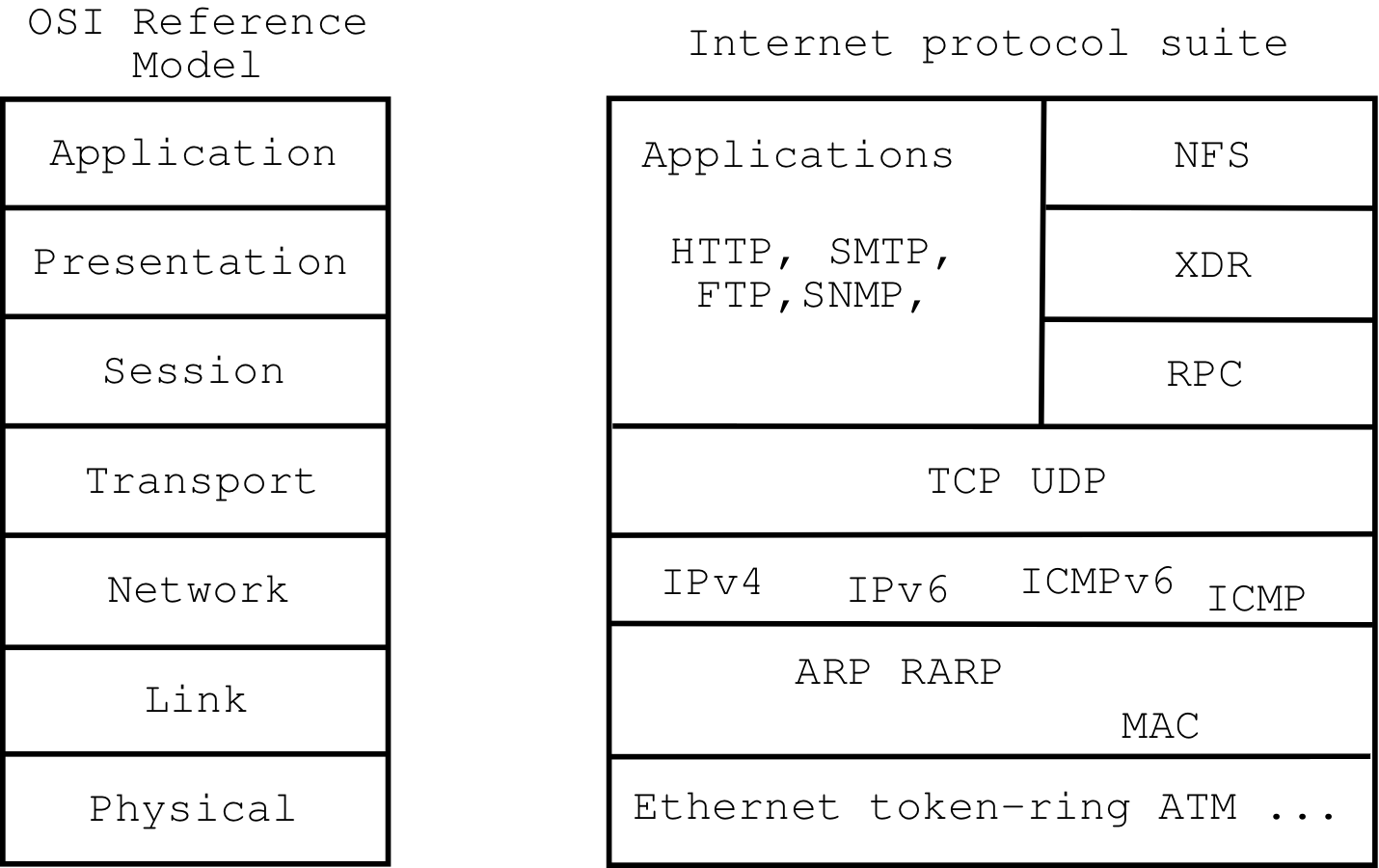
These stacks allow us to replace parts with better alternatives. So since the IPv4 address space was limited to 32-bit, it was decided to look for an alternative – which is IPv6 which has a much larger 128-bit address space.
Notes in this category
Notes mentioning this note
There are no notes linking to this note.